|
Getting your Trinity Audio player ready...
|
Manufacturers are under pressure from almost every direction. They need to respond to changing demand, labour shortages, supply chain uncertainty and, in some cases, new tariff pressures. With rising costs and tighter product margins, it’s probably not all that surprising that many manufacturing leaders are looking at software, automation, and AI to help them ramp up efficiencies.
To forecast more accurately or optimize production, companies must be able to pull reliable information from across the business. However, that’s a challenge. Data is spread across systems, spreadsheets and legacy applications, visibility is limited, and getting a complete picture of the business is tediously manual.
The Manufacturing Challenge: Efficiency
When manufacturers approach us looking for a solution to their pain points, the conversation often comes back to one thing: efficiency. Efficiency in manufacturing is not just about making things faster. It’s also about reducing waste in all its forms. From overproduction and excess inventory to defects and rework, waste shows up in a manufacturing setting in almost countless ways.
And each little efficiency breakdown has a quantifiable trickle-down effect. For example, if a part fails quality control after it has already gone through the production process, the cost is not just the item that now can’t be used, it’s the time, labour, machine usage, materials and downstream delays attached to it. In another scenario, products or materials sitting on a shelf may look like a buffer, but they also represent cash that has already been spent.
The bottom line is that manufacturers are looking to get closer to a “just-in-time” model where materials, parts and finished goods move in coordination with actual demand. To do that, manufacturers need better forecasting, and better forecasting is contingent on dependable information from across the business.
Why Visibility Is So Difficult in Manufacturing
Most manufacturers already have important systems in place. While the mix varies from company to company, ERP systems (like SAP or Oracle NetSuite), CRMs (like Dynamics 365), custom legacy software and industry-specific platforms are commonly used. The issue is that these systems do not always work together in the way the business needs.
Replacing those technologies is often too expensive and disruptive to be the first choice. When we speak to clients, they are looking for a way to connect existing systems and optimize their workflows. This could mean creating dashboards that pull from multiple systems or replacing manual spreadsheet reporting with Power BI. No one is looking to start over, but rather make what they have in place more useful and intelligent.
Another obstacle is that manufacturing data doesn’t stay neatly in one part of the business. It moves from customer orders and sales forecasts into inventory, production planning, reporting, and customer service. When that data is disconnected, both the customer experience and the operational side of the business feel the impact.
The Customer Experience Side of Manufacturing
For manufacturers, smarter operations aren’t just limited to what happens on the production floor. Client-facing systems also affect business. If contractors, resellers or other clients can’t easily place orders or get the timely updates they are looking for, it means that internal teams must fill the gap manually, slowing everything down.
For one manufacturing client, Whitecap’s work focused on building a fully custom B2B customer portal/platform to support a better customer experience, all while improving operational efficiency behind the scenes. Whitecap was tasked with creating a solution that ensured seamless online functionality for different user types and provided access to resources and support tools. This solution also had to connect with the company’s ERP system with the goal of enabling information to move between systems in real time to significantly reduce human intervention.
It’s a good example of how manufacturing modernization often works in real life. Many times, the immediate opportunity is to improve the business workflows rather than a new production machine or a full ERP replacement.
By improving the way data flows through the organization, manufacturers can then learn from customer behaviour, product trends and support needs. In other words, the customer experience and the operational experience are two sides of the same coin.
Streamlining the Reporting Process
Another common starting point for smarter operations is analytics. A worldwide manufacturing company was struggling with its reporting, which was siloed within Excel spreadsheets. Salespeople were generating their own reports manually from systems such as Salesforce and Navision, a legacy ERP.
The manufacturer turned to us to build a more efficient sales reporting tool, and the subsequent data engineering and modelling behind it. To bring that information together, we leveraged Power BI to pull from Salesforce and Navision, as well as coordinate sales forecast and sales budget numbers from the company’s head office server in another country. The finished reporting centred on two key areas, the sales pipeline and sales performance.
On the pipeline side, it was mission critical for sales executives to be able to instantly see open and closed won opportunities, win rate, stale or abandoned opportunities, estimated revenue, and opportunities by sales stage. On the performance side, it gave the team a month-by-month view of sales compared with the prior year, budget, and forecast.
With timely reporting, sales teams and leaders had a single source of truth to see how they were performing. They could look at sales trends month over month, compare performance against budget and forecast, and view results for specific clients or customers.
That kind of clarity gave them a clearer lens into what was moving, what was slowing down and where opportunities were being won.
Power BI for Shared View of Performance
In the manufacturing industry, there’s certainly no shortage of data. However, one person may be looking at a spreadsheet while another is pulling information from the CRM. Even when the numbers match up and are accurate, the process can create confusion, delay and duplicated effort.
This is where Power BI can really be a benefit. It helps by centralizing reporting and giving all stakeholders – from sales, production, customer service and beyond – a shared place to see trends and glean insights.
Power BI can support the specific dashboards required across the company. Whether it’s a sales team that wants to know exactly what’s in the pipeline, or an operations team that needs to gauge machine downtime and bottlenecks. The common theme is that reporting must be timely and trusted.
And that brings us to data engineering. A dashboard is only as good as the inputs behind it. Before reporting can become actionable, companies need to know where the information lives, how it is structured, who owns it and what needs to happen before teams can trust it.
Once that reporting foundation is in place, manufacturers can start to move from visibility to action. Reports can refresh automatically, workflows can move data between systems, and teams can be alerted when something needs attention. With this in place, we can now start to think about implementing analytics and automation.
Automation and Analytics Create Value Before AI
When we first speak to a potential manufacturing client, usually the first thing they ask about is AI. It’s understandable; AI has potential to support so many of the aspects of the manufacturing process: forecasting, predictive maintenance, quality control, customer service, and financial decisions.
This is where automation can create value before AI. Manufacturing has used automation for decades. Robots can stamp, weld and assemble, and programmable machines are already part of many production environments.
However, automation and analytics also exist on the business operations side, from automatically refreshed reports to workflows that move data from one system to another without someone having to tiresomely rebuild the same spreadsheet week after week.
That solves real problems by cutting out repetitive work and giving people more time to focus on decisions rather than data gathering. It also does something very exciting… it sets the groundwork for more advanced analytics and AI.
Are You AI Ready?
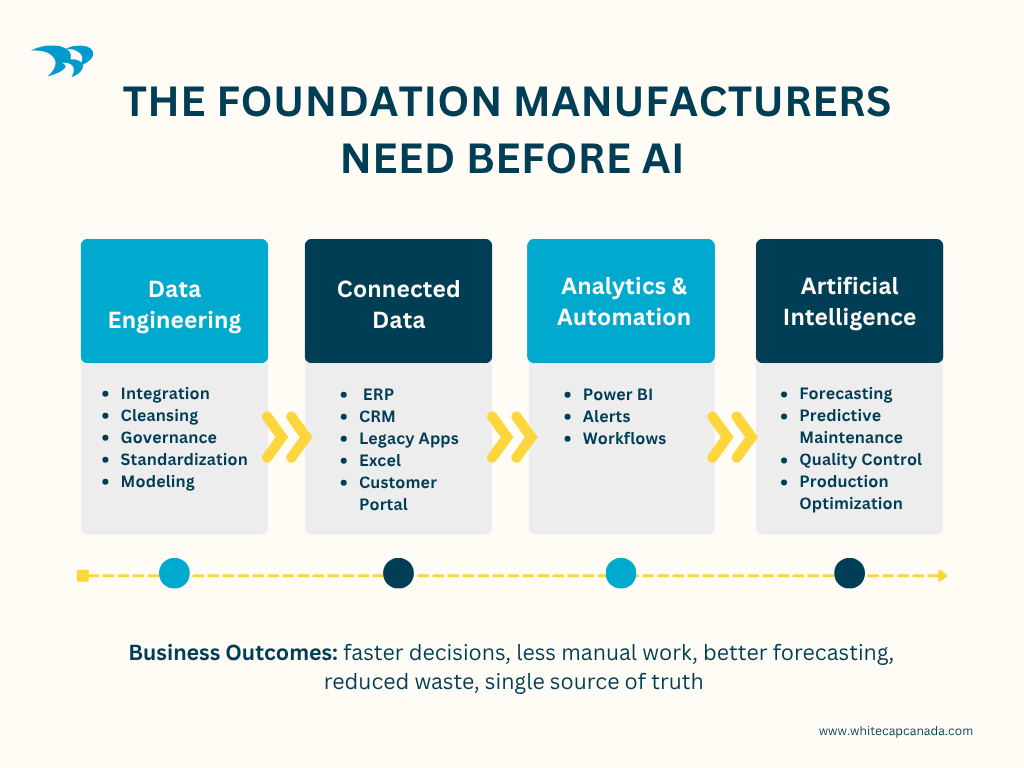
AI is not a magic wand that can be waved over disconnected systems and be expected to figure everything out. For AI to be valuable, manufacturers need clean, accurate data along with consistent and repeatable processes. If every team measures things differently, or if data is incomplete or outdated, AI will struggle to produce anything meaningful.
In manufacturing, as in all sectors, the potential use cases depend heavily on reliable inputs. Predictive maintenance needs accurate reporting around equipment performance and quality control needs consistent information on defects and production conditions. The same applies to production optimization.
If a manufacturer wants to understand bottlenecks or test different production approaches, it needs data that shows how the process is actually performing. In some environments, that may come from sensors on machines. A stamping machine, for example, might provide data on units produced per hour, as well as uptime, downtime or error rates.
That data can eventually support analytics, automation and AI, but only if teams are clear on what they are measuring, why it matters, and whether the information can be trusted.
Bonus: Get tips and actionable strategies for building an AI roadmap in your organization.
Modernization: The Practical Path to Smarter Manufacturing
The manufacturing tech-stack conversation can quickly become overwhelming. And while ERP, CRM, Power BI, Microsoft Fabric, automation, AI, sensors, legacy systems, custom software, and cloud platforms can all be part of the discussion, usually the best starting point is a lot simpler:
- What is slowing the business down?
- Where is manual work creating risk or delay?
- Which systems need to connect?
- What information do teams need faster?
- Where would a better line of sight improve decisions?
For some manufacturers, the answer may be a custom platform that improves customer experience and connects to the ERP. For others, it may be Power BI reporting that replaces manual Excel work and creates a clearer view of performance. The right solution depends on the business.
Manufacturers do not have to jump straight to AI to become faster or more efficient. The most valuable work starts with connecting systems and building a stronger data foundation.
Manufacturing Modernization FAQ
Q: What should manufacturers do before investing in AI?
A: Before investing in AI, manufacturers should identify operational challenges, evaluate their existing systems, assess data quality, and look for opportunities to improve reporting and automation. AI delivers the greatest value when it is built on reliable, accessible data and supported by consistent business processes across the organization.
Q: How is AI used in manufacturing?
A: Manufacturers can use AI to improve demand forecasting, predictive maintenance, quality control, production optimization, customer service, and supply chain planning. However, successful AI initiatives depend on accurate and well-governed data. Before implementing AI, manufacturers should focus on connecting systems, improving data quality, and establishing trusted reporting.
Q: What is a manufacturing data foundation?
A: A manufacturing data foundation is the combination of connected systems, clean data, standardized processes, and reporting tools that enable information to flow reliably across the business. It provides the visibility needed for analytics, automation, forecasting, and AI while helping teams work from a single, trusted source of information.
Q: Why is data visibility important in manufacturing?
A: Data visibility gives manufacturers a clear view of sales, inventory, production, quality, customer service, and financial performance. When teams can access accurate, up-to-date information, they can identify bottlenecks, improve forecasting, reduce waste, respond faster to issues, and make more informed business decisions.
Q: Why do manufacturers struggle with reporting?
A: Many manufacturers rely on multiple systems, including ERP platforms, CRM software, spreadsheets, and custom applications. Because these systems often operate independently, reporting becomes a manual and time-consuming process. This can lead to inconsistent information, limited visibility, and delays in decision-making across the organization.
Q: How does Power BI help manufacturing companies?
A: Power BI helps manufacturers bring together data from ERP systems, CRM platforms, production systems, spreadsheets, and databases into a single reporting environment. Organizations commonly use Power BI to monitor production performance, inventory levels, sales pipelines, quality metrics, machine downtime, and financial results through interactive dashboards.
Q: Do manufacturers need to replace their ERP or legacy systems to modernize?
A: Not necessarily. Many manufacturers can modernize by integrating existing systems, improving workflows, automating manual processes, and implementing better reporting tools. Modernization often focuses on making current technology more connected and efficient rather than replacing critical ERP or legacy systems that continue to support business operations.
Ready to Modernize Your Manufacturing Operations?
Whether you are trying to reduce manual reporting, connect existing systems, improve customer-facing workflows, or prepare your data for AI, Whitecap can help you identify the right starting point.
Our team works with manufacturers to build practical software, automation, analytics, and integration solutions that support smarter operations without forcing unnecessary disruption. Let’s talk!