|
Getting your Trinity Audio player ready...
|
For the past few years, the analytics conversation has been dominated by what comes next. Predictive analytics has become one of the hottest topics in business intelligence. By using historical and real-time data, statistical models, and machine learning, it helps organizations forecast likely outcomes and make smarter decisions.
However, in conversations with clients, we are seeing a different priority emerge. Before organizations can take advantage of advanced predictive analytics, they are focused on something more immediate and mission-critical: getting their data in order.
That shift is subtle, but significant. Right now, organizations around the world are operating, day in and day out, in a new and turbulent environment of economic pressure, geopolitical instability, shifting trade dynamics, and constant uncertainty. In this new environment, there’s a growing understanding that better decisions don’t start with prediction. They start with real-time visibility, trust and a shared understanding of what the data is actually saying right now.
The Reality Most Organizations Are Facing
Most teams are not struggling because they lack dashboards. They are struggling because of how much effort it takes to produce them. The issue is that data lives everywhere; inside CRM systems, financial platforms, operational tools, spreadsheets, and internal databases. They all hold part of the picture.
Teams pull data from different sources, often in slightly different ways. The context can be lost and insights, when they are gleaned, often arrive late. The need for manual reporting goes up and confidence in the data goes down.
From our feet-on-the-ground perspective, organizations are often held back less by a lack of AI tools and more by fragmented data, inconsistent reporting, and weak governance.
Before anything advanced can happen, that foundation needs to be addressed. Recent Gartner data and analytics conferences confirm that “data management leaders unable to feed multimodel data-hungry AI models will fall behind on executing their AI strategies.”
What We Mean by Modern Analytics
Let’s take a step back. If modern analytics depend on creating a cleaner, more connected data environment what does that mean? In practical terms, that plays out in these following ways:
- Bringing together data from multiple systems into a more unified structure
- Reducing duplication and conflicting versions of the truth
- Improving governance so teams know what data can be trusted
- Enabling faster, more reliable reporting and dashboards
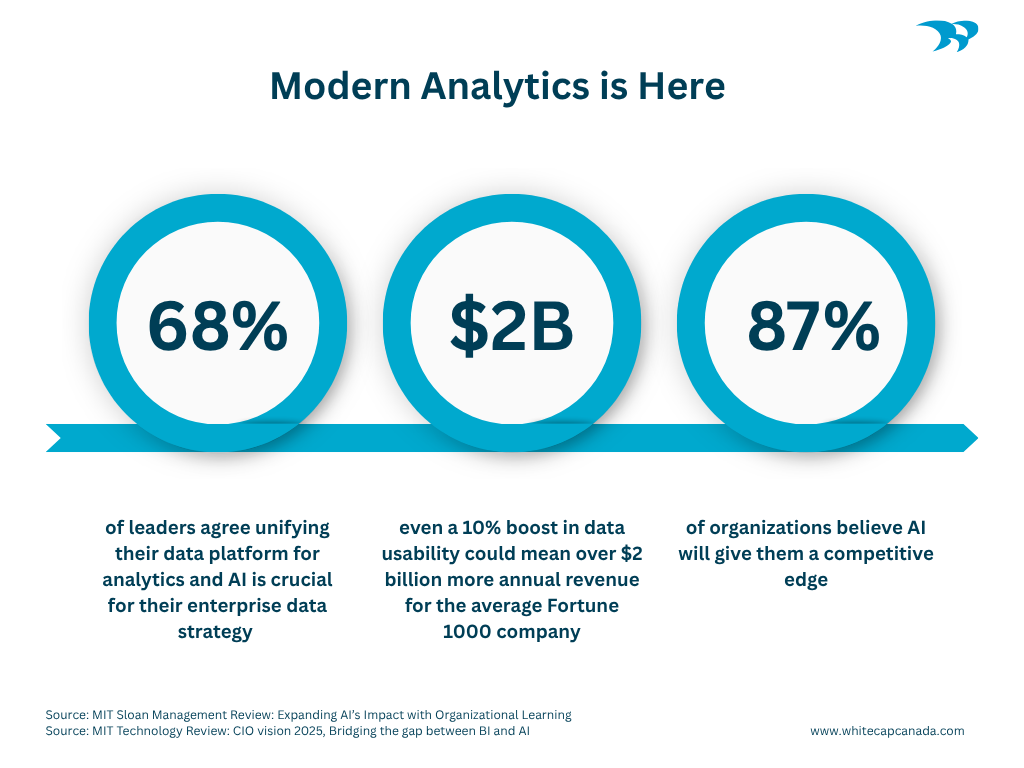
The goal is straightforward: spend less time assembling data, and more time using it and benefiting from it. This is the work many organizations are investing in currently, not just because it solves immediate business problems, but also because it has a direct impact on strategy, revenue and market position.
Why Architecture Matters More Than Tools
There is a temptation to approach analytics as a “tool problem.” If the right platform is in place, better outcomes will follow. As Yogi Berra famously said, “In theory there is no difference between theory and practice. In practice there is.”
While tools can accelerate what already exists, they cannot fix a fragmented or poorly governed data environment. This is why architecture matters.
Governance is where this becomes real. Faster access to bad data is still bad data. If ownership is unclear, definitions are inconsistent, or critical information is missing at the source, no platform can solve those issues on its own. Modern analytics works best when organizations address problems at the root; improving how data is captured, how it is managed, and whether your people have full trust in it before it ever reaches the dashboard.
Modern analytics platforms, including Microsoft Fabric, are designed to bring data integration, analytics, and governance closer together. The goal is not simply better reports. It is to create a stronger foundation for how information flows across the business and how decisions are made from it.
New Fabric Features We’re Excited About
Take something as simple as reporting from spreadsheets, SharePoint folders, CRM systems, or financial platforms. Traditionally, teams would pull data manually, move it between systems, schedule refreshes, and spend hours maintaining pipelines just to keep reports current and mostly trustworthy.
Our team sees incredible potential (and cost savings) in newer Microsoft capabilities like shared data layers, mirroring, and shortcuts.
Shared Data Layers
Fabric’s OneLake acts as a shared data foundation, helping organizations reduce duplication by storing data once and allowing multiple teams to work from the same source of truth. Instead of creating multiple copies of the same information, teams can access the same trusted data across reporting, analytics, and planning.
Mirroring
Fabric’s mirroring capabilities take that a step further. Rather than constantly copying data from operational databases into reporting environments, it allows organizations to work with that data where it already lives. So, think of it akin to streaming rather than downloading. That means faster access, fewer broken pipelines, and less maintenance overhead.
Shortcuts
Shortcuts offer an advantage for organizations still relying on spreadsheets, CSV files, and shared folders for reporting. Traditionally, those reports depend on scheduled refreshes and constant manual maintenance to stay current. Shortcuts create a more direct connection, allowing updates to flow into Fabric in near real time as files change. The result? Faster reporting, fewer delays, and less time spent managing everything happening behind the dashboard.
Yes, these technical features matter, but only because of what they solve: less manual work, fewer silos, more trust in reporting, and faster decision-making. When that architecture is in place, everything else becomes easier.
How to Get Started
One of the more encouraging changes is how organizations are approaching this work. Rather than attempting a large-scale transformation all at once, many are starting with a focused use case. This might be a single business area, a priority reporting challenge or a defined set of data sources. From there, the goal is to build a working foundation, demonstrate value, and expand over time.
This approach does two things. It reduces risk, and it makes the benefits tangible. Teams can see the impact of cleaner, more connected data without waiting for a long, complex implementation to finish. As importantly, it also creates momentum. Once a trusted data layer is in place, additional use cases become easier to support.
Increasingly, organizations are also recognizing that the real value is not in endlessly building new report variations, but in creating the consistent architecture underneath them. Once that foundation is in place, internal teams can often handle more of their own Power BI reporting and dashboard creation, while specialists focus on the more complex work of data modelling, governance, and long-term strategy.
That move creates more self-sufficiency across the business and ensures external expertise is being used where it delivers the greatest impact.
Where Advanced Analytics Fits In
This is where predictive analytics and other advanced capabilities come back into the picture. Make no mistake, they are still important and often, ultimately the end goal. But they are not the starting point.
Advanced predictive analytics depends on having consistent, reliable data. Without that, any forecast is simply less accurate, and AI-driven insights can quickly become misleading. With a strong modern analytics foundation, those capabilities become far more practical. Organizations can begin to explore forecasting and trend analysis, along with more automated planning and reporting processes. The key is that these are enabled by the foundation, not separate from it.
Modern analytics delivers immediate improvements. Advanced analytics builds on top of them.
Quick FAQ
Q: What is modern analytics?
A: Modern analytics is an approach to data that focuses on clean, connected, and well-governed data environments. It brings together data from multiple systems into a unified structure, enabling faster, more reliable reporting and real-time decision-making.
Q: What is advanced analytics?
A: Advanced analytics uses statistical models, machine learning, and predictive techniques to forecast future outcomes and identify trends. It builds on a strong data foundation to provide forward-looking insights that support strategic decision-making.
Q: What is the difference between modern analytics and advanced analytics?
A: Modern analytics focuses on preparing and organizing data for accuracy and accessibility, while advanced analytics uses that data to generate predictions and insights. Modern analytics is the foundation; advanced analytics is the next step built on top of it.
Q: Why is modern analytics important before implementing AI?
A: AI depends on high-quality, structured, and connected data. Without a strong modern analytics foundation, AI can produce unreliable or misleading results. Clean data and strong governance ensure AI delivers accurate and trustworthy insights.
Q: How can organizations get started with modern analytics?
A: Organizations should start with a focused use case, such as improving a specific report or data source. From there, they can build a unified data layer, improve governance, and gradually expand to additional systems and use cases.
A More Practical Path Forward
What we are seeing currently across our client conversations as well as in the market is a more grounded approach to analytics. Organizations are still interested in what AI and predictive analytics capabilities can offer. But they are increasingly focused on getting the basics right first. That means investing in architecture, cleaning and connecting data, and establishing a single source of truth. Only then can you really leverage AI.
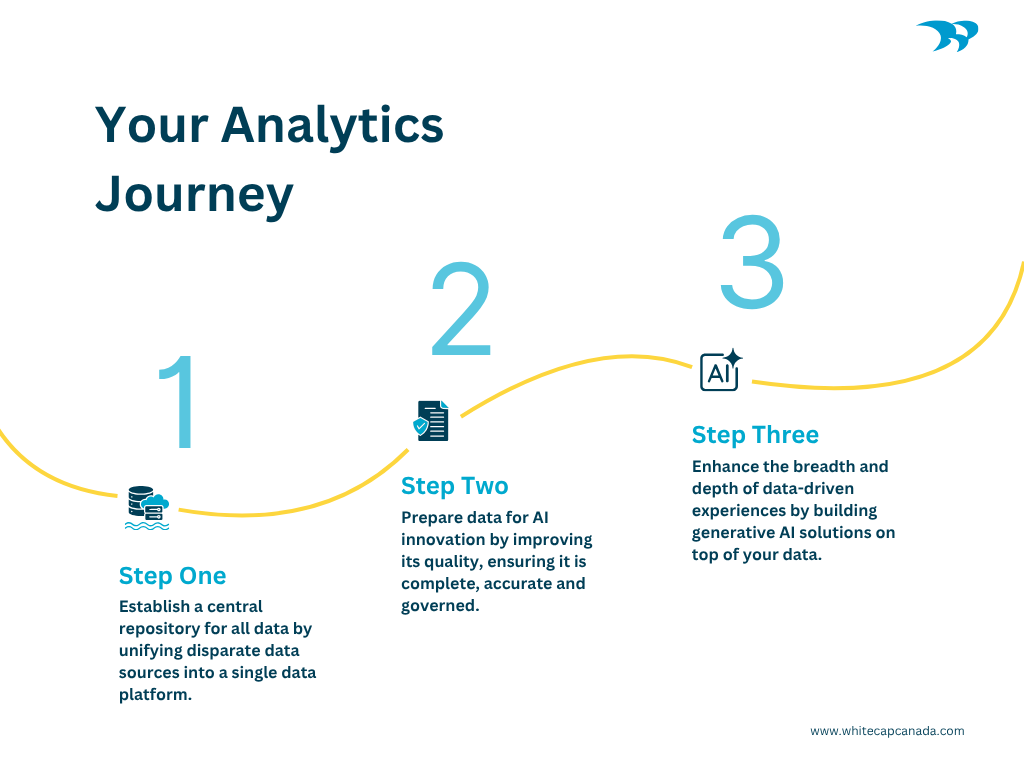
These are not small improvements. They change how teams work with data every day. And they create the conditions for more advanced capabilities to deliver additional value, rather than just theoretical potential.
Looking for Dependable Data?
Modern analytics is not about chasing the next trend. It is about building the right foundation so your organization can move faster, make better decisions, and scale future AI capabilities with confidence.
If you are evaluating how to move beyond manual reporting and create a more connected, future-ready data environment, Whitecap’s Microsoft Fabric consulting service can help you turn data into a true business advantage. Let’s talk!