|
Getting your Trinity Audio player ready...
|
Artificial intelligence is changing software development at an incredible pace. Today, anyone can describe an idea in plain language and have an AI tool generate a working app prototype in minutes. Platforms like Claude, Lovable, Bolt, Replit Agent, Cursor and GitHub Copilot are making it easier than ever to build software without writing every line of code yourself.
For many businesses, that’s an exciting prospect. Why invest in a custom application when AI can seemingly do it for a fraction of the cost? The reality is more nuanced.
AI is becoming an invaluable tool for software development, and many organizations should absolutely be experimenting with it. Our team certainly is, and we documented our AI adoption strategy in a previous post.
But there’s a line worth drawing. AI is very good at some parts of building software but not so good at others. Knowing where that line sits matters, especially when the system is business critical. There is a clear point at which professional software development still provides significant value.
What Is “Vibe Coding”?
You’ve probably heard the term “vibe coding.” It refers to building software by describing what you want in natural language and allowing AI to generate the application for you. Instead of writing code line by line, you guide the AI through prompts, review the output, make adjustments, and continue refining the application.
The promise is exciting. Tasks that once took days can now potentially be completed in hours, and businesses can validate ideas much faster than ever before.
But before you make vibe coding your new software strategy, it’s worth considering some of the implications. Though the app may “work” as intended, there are some technical and business risks you may be introducing.
When AI App Builders Work Well
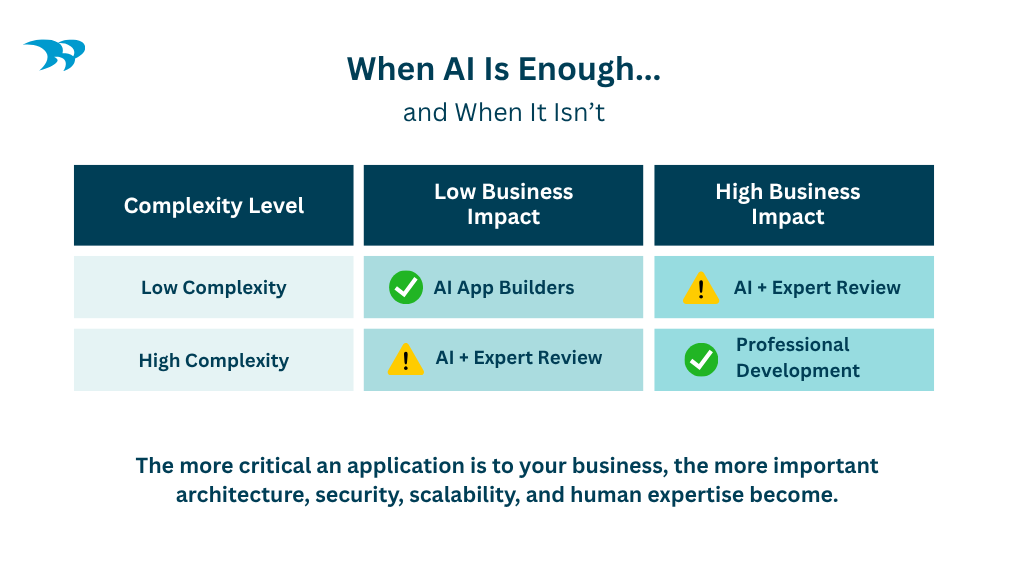
AI-generated applications can be a good choice for projects or app prototypes where speed and affordability are more important than long-term complexity.
Some good examples include:
- Internal productivity tools
- Department-specific applications
- Workflow automation
- Proof of concepts (prototypes)
- Minimum viable products (MVPs)
- Early-stage startup ideas
- Learning and experimentation
If you’re trying to answer the question, “Will this idea work?” AI can dramatically reduce the time and cost required to find out.
For many organizations, that’s exactly the right place to start.
Where Businesses Should Be More Cautious
As applications become more important to your business, the conversation shifts from simply getting something working to ensuring it remains reliable, secure, scalable, and maintainable over time.
Here are a few areas worth considering before relying solely on AI-generated code.
Security & Compliance
If your application stores customer information, financial records, employee data, or other sensitive information, security becomes far more than a checklist item.
Professional software development teams design applications with authentication, authorization, encryption, secure coding practices, auditing, and regulatory compliance in mind. While AI can generate secure code, it doesn’t understand your organization’s security policies, compliance requirements, or risk tolerance without careful human oversight.
Recent research highlights why that oversight matters. Veracode found that nearly 45% of AI-generated code samples contained OWASP Top 10 security vulnerabilities, with little improvement across successive model releases. Escape.tech analyzed more than 1,400 AI-generated applications and found that 65% contained security issues, while 58% included at least one critical vulnerability, such as exposed secrets or sensitive customer data. Meanwhile, a Stanford University study found that developers using AI coding assistants produced insecure code significantly more often on security-sensitive tasks and were more likely to believe their code was secure when it wasn’t.
For organizations in regulated industries such as healthcare, financial services, insurance, and government, these risks reinforce the importance of experienced developers reviewing, validating, and securing AI-generated code before it reaches production.
Business Growth
Many AI-generated applications work well for a handful of users.
But what happens when your business grows?
Can the application support hundreds or thousands of users? Will it continue performing well as more data is added? Can new features be introduced without breaking existing functionality?
Software architecture becomes increasingly important as applications mature. Decisions made during the initial build can have a significant impact on future performance, flexibility, and development costs.
Ongoing Maintenance
Launching an application is only the beginning.
Every application requires ongoing maintenance, including:
- Bug fixes
- Security updates
- Dependency upgrades
- Platform and runtime end of support (databases, frameworks, operating systems)
- Performance improvements
- Feature enhancements
- Compliance and regulatory changes
A question every business should ask is:
Who will maintain this application now and two or three years from now?
If the original prompts are lost, the generated code is difficult to understand, or no one fully understands how the application was assembled, future updates can quickly become more difficult and more expensive.
System Integration
Most organizations don’t need a standalone application. They need software that integrates with the systems they already rely on.
That might include:
- ERP systems
- CRM platforms
- Microsoft 365
- SharePoint
- Dynamics 365
- Power BI
- Payment gateways
- Third-party APIs
These integrations often represent some of the most technically challenging aspects of a software project. While AI can certainly assist with integration development, designing reliable, secure, and maintainable integrations still requires experience and architectural planning.
Technical Debt
One of the biggest advantages of AI-generated software is speed. Ironically, speed can also become its biggest disadvantage.
Applications built quickly without careful planning often accumulate technical debt—shortcuts in architecture or implementation that make future development slower, riskier, and more expensive.
For a short-lived prototype, that may not matter. But if your business plans to rely on the application for the next five to seven years, those shortcuts can become costly. Gartner expects architectural technical debt to become the dominant form of technical debt, predicting that by 2027 it will account for 80% of all technical debt. Unlike code-level issues that can often be fixed quickly, architectural decisions made early in a project are much more difficult, and expensive to undo.
Upfront Cost vs Long-Term Return
AI can significantly reduce the upfront cost of building software, making it an attractive option for many projects. But software should rarely be evaluated on development cost alone.
A better question is: what will this application cost to own over its entire lifetime?
An AI-generated application may cost less to launch, but if it requires significant rework, ongoing maintenance, security improvements, or even a complete rebuild as your business grows, those initial savings can disappear quickly. Professionally developed software typically requires a larger upfront investment, but that investment often pays off through stronger architecture, easier maintenance, better scalability, improved security, and a longer useful lifespan.
It’s also important to consider the ongoing cost of AI development itself. Gartner predicts that by 2027, 40% of enterprises using consumption-based AI coding tools will exceed their expected budgets by more than two times. Because these platforms charge based on usage, costs can grow quickly and become difficult to predict.
The lowest-cost solution today isn’t always the lowest-cost solution over the next five years.
Here are some software budgeting tips.
Should You Build Your App With AI?
In some cases, yes.
But if you’re building software that supports core business operations, handles sensitive information, serves customers, or needs to evolve alongside your organization, it’s worth thinking beyond the first version.
The question isn’t simply whether AI can build your application.
It’s whether that application will remain secure, maintainable, scalable, and adaptable as your business grows.
We Asked Our Experts
The debate about when and how much to rely on AI is happening in all organizations, including ours. Our own software developers are experimenting with AI development tools to see where they might save time and where they fall short.
We asked a few of our team members to share their thoughts on building apps with AI and here’s what they had to say:
AI is not yet at a place where it can go from design to a finished product. Human designers/developers are required to guide AI towards reliable, maintainable, code that will satisfy underlying business requirements. While AI can generate a large body of internally consistent code using simple prompts, it cannot maintain context across large implementations with complex interrelationships. Not without a human in the loop. That may change in the future, but human intervention will always be needed to some degree.
Charles Horan, Solutions Architect, Senior Software Developer
AI can help anyone build an app quickly, but speed isn’t the same as quality. Production-ready software still depends on experienced engineers to provide the right context, validate AI-generated output, and ensure the architecture, security, oversight, and accountability needed to deliver reliable systems. I believe agentic AI is the future, but that doesn’t make software engineering less important. It makes strong engineering fundamentals like system design, architecture, security, and validating AI-generated code even more valuable.
Tania Perez Ramirez, Senior Software Developer
Someone recently showed me a Canvas App that AI had built. It was a thing of beauty. It ignored the business requirements and wouldn’t have worked, but it was a marvel to see. When it comes to creating an accurate list of business requirements for an application, AI is no substitute for an experienced, human solutions architect and developer.
Michael Manning, Solutions Architect, Dynamics 365 CRM
I have never seen a client regret spending more time on requirements. I have seen plenty regret spending less. AI has not changed that; it has just made it much easier to skip the part you will regret skipping down the line.
Dan Carmichael, President
AI App Development FAQ
Q: Can AI build a production-ready business application?
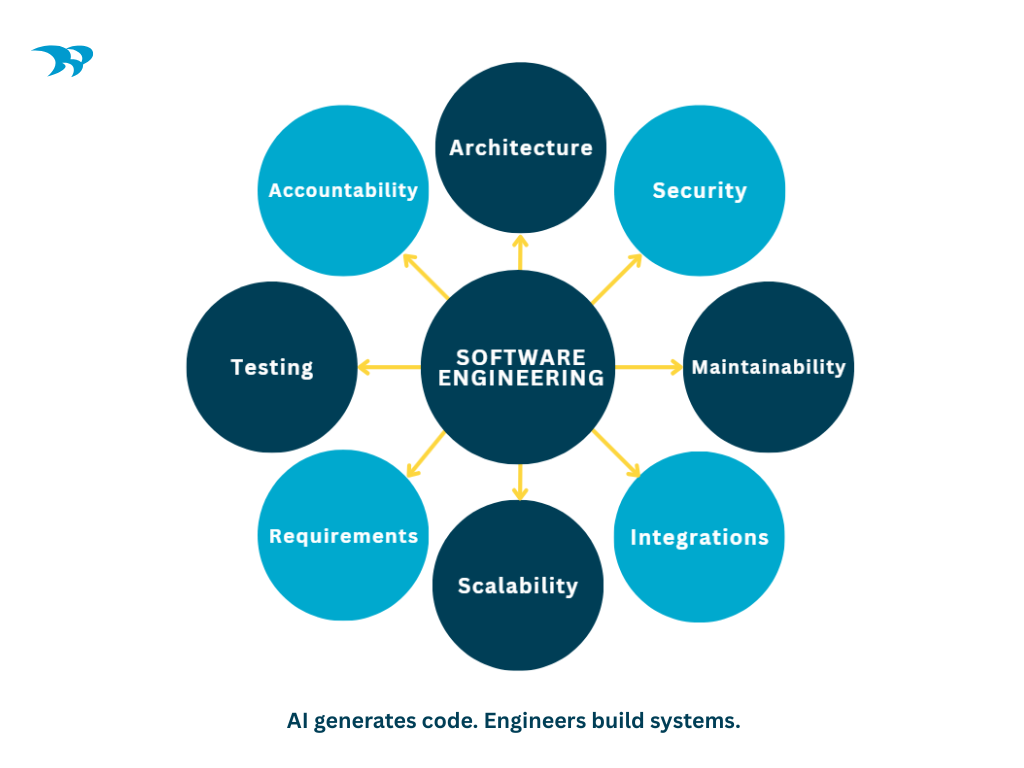
A: AI can generate functional applications and significantly accelerate development, especially for prototypes, internal tools, and minimum viable products (MVPs). However, production-ready business applications often require experienced software engineers to ensure the solution is secure, scalable, maintainable, integrates with existing systems, and meets long-term business requirements.
Q: Is building an app with AI always cheaper?
A: AI can significantly reduce the initial cost of building an application, particularly for simple projects. However, businesses should also consider the total cost of ownership, including maintenance, security updates, scalability, future enhancements, and potential redevelopment. In many cases, investing more upfront in a well-engineered application results in lower long-term costs.
Q: Can AI-generated applications be maintained over time?
A: They can, but maintainability depends on how the application was designed and documented. Applications built quickly without a solid architecture can become difficult to update, troubleshoot, or extend as business requirements evolve. Experienced developers help ensure the application remains maintainable throughout its lifecycle.
Q: How do I decide whether to build my app with AI or hire a software development company?
A: Start by considering the importance of the application to your business. If you need to validate an idea quickly or build a simple internal tool, AI may be all you need. If the application will become a core business system, support customers, handle sensitive information, or require long-term scalability and support, working with an experienced software development team can help reduce risk and maximize long-term value.
The Future Isn’t AI vs. Developers
The conversation isn’t about AI versus developers. It’s about what each does best.
AI has transformed how software is built. It accelerates coding, automates repetitive work, improves testing, and helps experienced teams deliver solutions faster than ever before. Used well, it’s a powerful force multiplier.
But successful software has never been defined by how quickly code is written. It is defined by the quality of the decisions behind it.
Experienced software engineers bring the judgment to design resilient architectures, understand business goals, manage risk, protect security, and build systems that can evolve as organizations grow. They know which shortcuts are safe to take, and which ones will become tomorrow’s costly technical debt.
AI can generate code. Experienced developers engineer solutions.
The organizations that will succeed aren’t choosing between AI and experienced developers. They’re combining AI’s speed with human expertise to deliver software that’s not only built faster but built to last.
If you’re looking for a team that embraces modern AI tools without compromising on quality, security, or long-term maintainability, we’d be happy to discuss your next project. Let’s chat.