
|
Getting your Trinity Audio player ready... |
Jack Golabek, Whitecap’s Business Development Executive, keeps hearing the same thing from prospective clients. They want to improve their business, but they’re wary because a lot of the AI hype hasn’t panned out. If they can’t see a return, they don’t want to move forward.
And, they have good reason to be careful. According to Gartner’s CIO Planning for 2027, IT budgets are projected to grow by an average of just 3.7% in 2027, while funding for agentic AI is expected to jump 31.8%, making it the fastest-growing area of technology investment. Although AI is often pitched as a way to cut costs, 51% of CIOs expect it to increase total cost of ownership over the technology life cycle.
Budgets are barely moving, yet the options keep multiplying and few organizations have the people to sort through them all. So where should you invest your technology budget in 2027?
We put the question to Jack and to Charles Horan, a Solutions Architect and Senior Software Developer. Charles pointed out, with some amusement, how unusual it is for tech to agree with sales. On this topic, they agreed on nearly everything: start with the business problem, move in small steps and measure what happens.
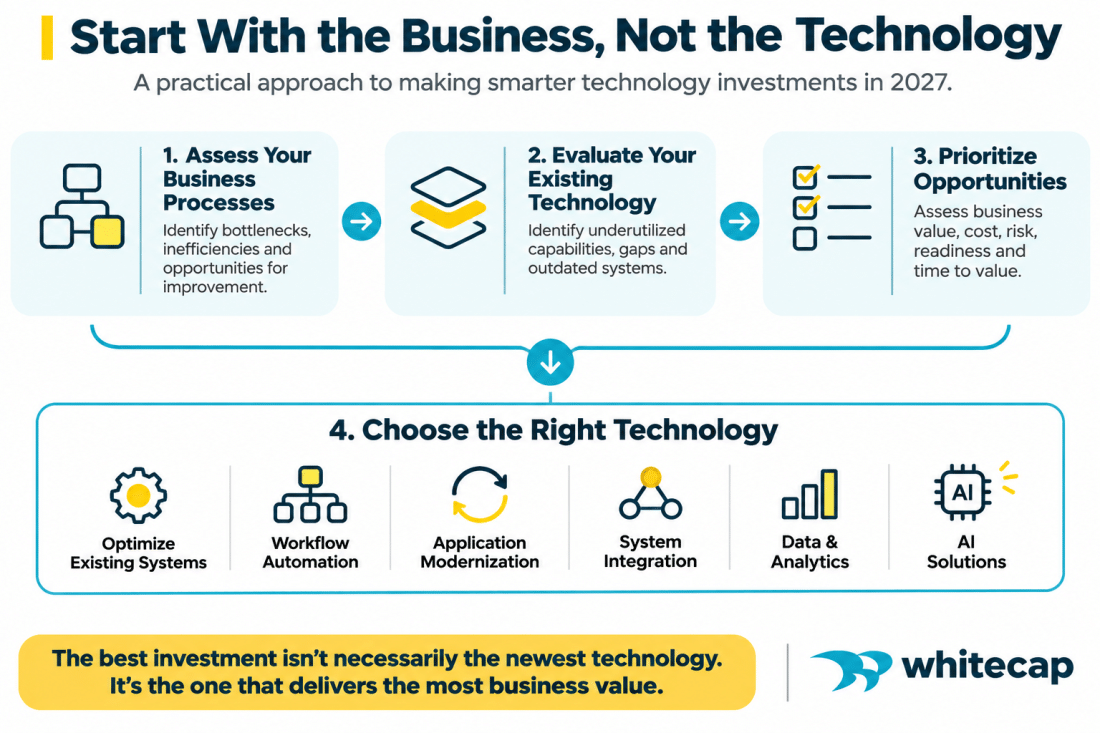
Start With the Business Problem, Not the Technology
Before allotting any of your budget, take a good look at how the work gets done. Where does information get held up between departments? Which manual processes are taking more time than they should? Often, the answer doesn’t involve a sophisticated new system or AI at all.
Charles has seen this firsthand: “I’ve lost track of the number of companies that I interact with where their idea of workflow management is, ‘Hey, Pete, can you take care of this?’”
In many cases, introducing some basic workflow management could make a significant difference. Tools such as Microsoft Power Automate can handle approvals, notifications and repetitive tasks without introducing AI and its additional complexity.
Jack’s advice is to keep it manageable. “Go one workflow at a time,” he says. “Don’t try to drink the ocean.” See what improves, then decide where to go next. That gives businesses a practical way to make improvements without taking on too much at once.
Helpful follow up read: AI Agents vs Traditional Automation: Does your Business Process Really Need an Agent?
Look at What You Have Before Buying Something New
Your existing technology can often do more than you realize. Before buying a new application or platform, take a closer look at what you already have and whether it could do the job.
Charles sees plenty of opportunities to improve existing systems without introducing AI: “There’s a lot of room in your existing technology stack to improve it without moving into AI. And those improvements are probably going to get you bigger bang for the buck initially.”
Microsoft 365, for example, includes document management, collaboration and workflow tools that many businesses aren’t using to their full potential.
Naturally, some systems really do need attention. When that’s the case, there are three options to consider:
- Modernize: If an application still does what you need, updating it may be enough. Unsupported software should be addressed before it becomes a bigger problem.
- Integrate: If systems aren’t sharing information effectively, connecting them through APIs may help. This can be a more involved project and requires the right technical resources.
- Replace: If an application is no longer supported or doesn’t meet your requirements, it’s time to start fresh. This is also an excellent opportunity to revisit features that weren’t practical or affordable when the system was originally built.
Learn more about application modernization approaches.
Four Signs Your Organization May Not Be Ready
Even a promising technology investment can run into trouble if the organization isn’t prepared for it. This is especially true with AI, where expectations often get ahead of the resources and expertise needed to make it work.
Charles identifies four warning signs:
- You’ve done little more than read about the technology. Blogs, articles and demos can give you ideas, but have you looked seriously at how AI would work with your existing processes and systems?
- You don’t have the expertise in-house. You need people who understand both the technology and your business. If you don’t have that expertise, are you developing it or getting outside help?
- There’s no room in the budget. AI can be cost-effective, but it isn’t cheap. Charles estimates that a relatively small AI initiative can require the equivalent of half a full-time employee, while a medium-sized project can take 1.5 full-time employees over the course of the work.
- Your organization is slow to embrace change. There’s nothing wrong with introducing AI gradually. But if even small changes to how people work are slow, it may be difficult to get the most out of the technology.
If any of this sounds familiar, it doesn’t necessarily mean you have to abandon the investment. You may simply need to address some gaps first or start with a smaller proof-of-concept while you build the skills and experience to take on more.
Prioritize Investments Based on Measurable Business Value
From custom software development to AI implementation, most businesses have more technology projects they’d like to pursue than they have budget. Deciding which ones move forward means looking beyond the purchase price to consider implementation costs, ongoing support, time to value and what the investment will do for the business.
One way to compare competing projects is to ask the same questions of each:
| Consideration | Questions to ask |
| Business value | What problem will this solve, and what improvement can we expect? |
| Cost and resources | What will implementation, maintenance and ongoing support require? |
| Time to value | How soon can we expect to see benefits? |
| Risk | What risks will the investment reduce, and what new risks might it introduce? |
| Readiness | Do we have the systems, data and people to support it? |
| Measurement | How will we know if it worked? |
Some returns are pretty straightforward to calculate. Workflow automation is a good example.
If you do a workflow automation, you can actually calculate and predict what the ROI might be. – Jack Golabek
You can estimate the time saved, the reduction in manual work and improvements in accuracy. Better reporting and business intelligence can also help managers make decisions based on more current information, with alerts when something isn’t going as expected.
Reduced risk has a value too. For example, AI can scan contracts and other business documents for wording that could expose an organization to liability. You can estimate the potential savings by weighing the likelihood of something going wrong against the cost if it does.
Customer experience is trickier. While we all understand that automating customer service can reduce labour costs, how many times have we become frustrated by a chatbot that can’t answer a simple question or a phone menu that makes it nearly impossible to speak to a real person? Those experiences can drive customers away, potentially wiping out any savings.
Of course, automation done well can improve customer service. The trick is knowing whether it’s making life easier for your customers or just cheaper for your business.
Whatever benefits you’re expecting, Charles’s advice is to establish a real metric you can measure against. A project that looks promising isn’t enough; you need some way of knowing whether it delivered what you were expecting.
Don’t Overlook Security and Risk Reduction
With so much attention on AI, automation and new technology, it’s easy to overlook investments in cybersecurity. But how much a business should spend on security depends on the risks it faces and what a breach or system failure could cost.
A healthcare organization holding sensitive patient records, for example, faces very different risks from those of a retailer that uses an external payment processor and doesn’t store credit card information. Security investments should reflect those differences.
And the risks go beyond stolen data. As Charles notes, compromised automation can be even more damaging than a data breach. If someone interferes with how records move through a system or how equipment operates, the consequences can be serious.
AI is changing the security landscape as well. It can help organizations identify vulnerabilities and monitor systems, but it also gives attackers new ways to find weaknesses and exploit them.
Two recent articles by Whitecap colleagues explore these developments. Tania Perez Ramirez examines how AI is being used to discover software vulnerabilities in Beyond the Prompt: How Patch the Planet Uses AI to Discover Vulnerability Variants. Pratap Mahendran explores increasingly sophisticated attacks in AI and Social Engineering: How Cyberattacks Are Becoming More Sophisticated.
The important thing is to assess where your business is most exposed, what the consequences could be and which investments do the most to reduce those risks.
Build a Roadmap That Allows You to Learn and Adjust
Once you’ve decided where to invest, you need a plan for moving forward. What that plan looks like will depend on where your organization is today, what you want to accomplish and the resources you have available.
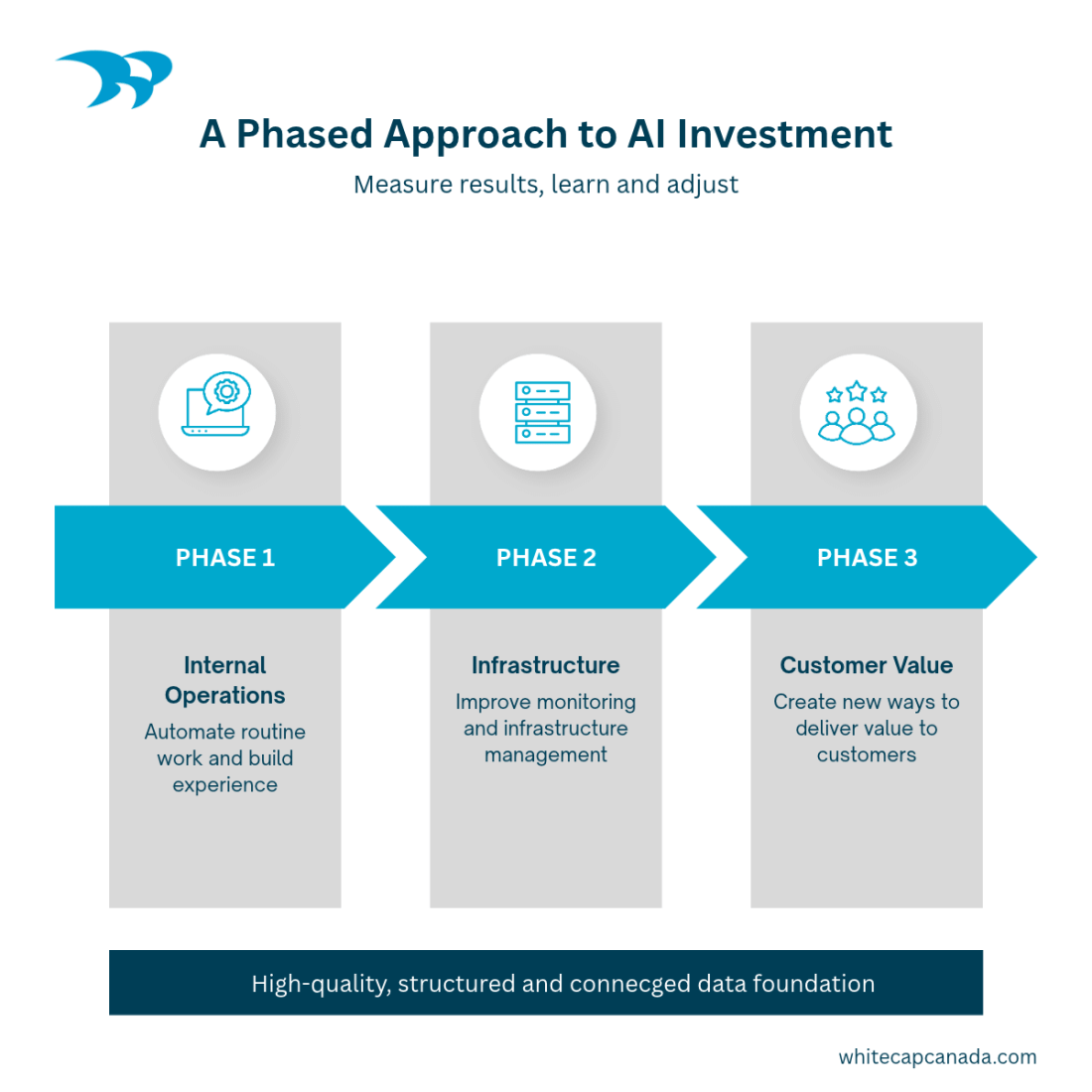
For businesses looking to expand their use of AI, Charles suggests a general progression:
- Start with internal operations. Look for opportunities to automate routine work, improve productivity and build experience using AI in a lower-risk environment.
- Move into infrastructure. As your team gains experience, consider more complex applications such as threat monitoring, infrastructure management and automated provisioning. This is also an opportunity to strengthen how AI is monitored and managed across the organization.
- Look for ways to provide more value to customers. Once you’re comfortable managing AI internally, explore how it could help your customers beyond the products or services you already provide.
For example, a supplier could use AI to monitor a customer’s usual ordering patterns and send an alert when purchases move significantly above or below normal levels. That information could help the customer spot a potential problem or adjust their purchasing decisions.
Helpful follow up read: AI Strategy for Business Leaders: Should You Start with Efficiency or Growth
It’s important to note that AI depends on high-quality, structured, and connected data. Without a strong modern analytics foundation, AI can produce unreliable or misleading results. Cleaning and preparing your data are crucial first steps in any AI project, big or small.
Whatever the roadmap looks like, it’s important to establish expectations before each project begins and compare them with the actual results.
Before you start, what’s your expectation? What’s the measurement at the end? As long as that gap keeps getting smaller, you’re doing good. If it starts getting bigger, you’re doing bad. Pull back. – Charles Horan
Over time, those results should help you make better decisions about what to tackle next, what needs more work and whether or not an investment is worth continuing.
Making Smarter Technology Decisions in 2027
Not every business needs to invest in AI next year. The right answer depends on the business, which is where we start. Jack describes our approach this way: “We’re not technology first. We’re solutions based.” Charles goes a step further: “The code is literally a side effect… what we really do is get involved with our clients, understand their business and their needs, and then lay out a strategic map.”
Planning your technology investments for 2027? Talk to us to discuss your priorities and explore where technology can deliver the greatest value for your business.
Frequently Asked
Q: How should businesses prioritize technology investments in 2027?
A: Businesses should prioritize technology investments based on measurable business value, implementation costs, time to value, risk reduction and organizational readiness. Start by identifying operational inefficiencies, outdated systems and opportunities for improvement. Compare potential projects against consistent criteria, establish clear success metrics and focus on investments that address the most pressing business needs rather than following technology trends.
Q: What technology investments offer the best ROI for businesses?
A: Technology investments that solve clearly defined business problems often deliver the strongest return on investment. Workflow automation can reduce manual work and improve accuracy, while business intelligence tools can support faster, more informed decisions. Application modernization and system integration can also deliver value by improving existing technology without requiring complete replacement. The best ROI depends on the organization’s priorities, costs and ability to measure results.
Q: Should businesses invest in AI or traditional automation in 2027?
A: Businesses should evaluate whether their processes actually require AI before investing. Traditional automation tools, such as Microsoft Power Automate, can efficiently handle structured, repetitive tasks like approvals, notifications and data transfers. AI may be more appropriate for processes involving unstructured information, interpretation or complex decision-making. Some processes benefit from combining both approaches. Start with the business problem and select the simplest technology that can reliably solve it.
Q: Is it better to modernize existing software or invest in new applications?
A: Modernizing existing software is often more cost-effective when the application still meets business requirements but needs improvements in performance, security or functionality. Integrating existing systems can also improve efficiency and data accessibility. Replacing software may be necessary when it is unsupported, difficult to maintain or no longer meets business needs. Organizations should assess modernization, integration and replacement options before committing to a new application.
Q: How can businesses determine whether they are ready to invest in AI?
A: AI readiness depends on several factors, including technical expertise, available budget, employee willingness to adopt change and the quality of existing data and systems. Businesses should identify specific AI use cases, assess integration requirements and determine whether they have the resources to implement and maintain a solution. Organizations with readiness gaps can begin with smaller proof-of-concept projects while strengthening their data foundations and internal capabilities.
Q: How can businesses create a technology investment roadmap for 2027?
A: An effective technology roadmap begins with clear business objectives, an assessment of existing systems and a prioritized list of opportunities. Organizations should identify achievable projects, estimate costs and resources, and establish measurable success criteria. For AI adoption, a phased approach might begin with internal productivity improvements before expanding into infrastructure management and customer-facing applications. Regularly reviewing results allows businesses to adjust priorities and make better investment decisions over time.