|
Getting your Trinity Audio player ready...
|
Most organizations have spent years digitizing work. Forms became apps. Spreadsheets became dashboards. Processes were automated. In many cases, it delivered real value and ROI.
But problems lurked under the surface. Data stayed fragmented across systems. Automations broke when anything changed. Analytics lagged behind the decisions they were meant to support. And teams still patched gaps by hand when the tools didn’t connect.
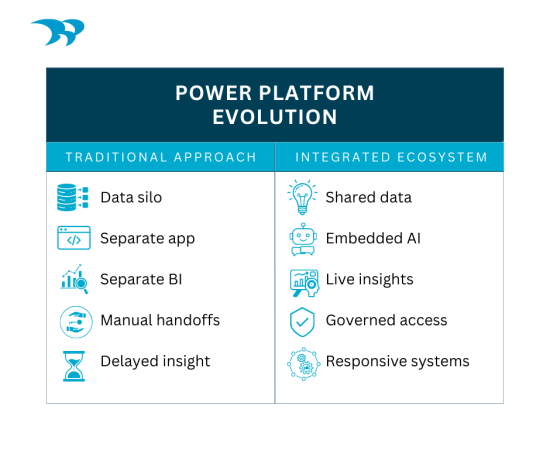
Why? Because data platforms, applications and automation have typically evolved in separate stacks. Data is captured in one place, then duplicated and shaped for reporting using extra pipelines and handoffs, slowing everything down and causing delays.
Microsoft’s Integrated Ecosystem Model
To address this, Microsoft has been reshaping how Microsoft Power Platform, Microsoft Fabric, and AI come together. Rather than treating data, applications, automation, analytics, and AI as separate lanes, the focus has turned to converging them into a single ecosystem. The result is fewer handoffs, less duplication, and faster insights. It means intelligence that moves across systems instead of getting trapped inside them.
The integrated ecosystem model aims to close gaps by bringing the three layers closer together for a more continuous flow, from data, to insight, to action:
- Unified analytics foundation, centred on Microsoft Fabric and OneLake
- One low-code execution layer, through Microsoft Power Platform connected to Fabric via Dataverse-to-OneLake integration
- One AI layer, where Copilot and Azure OpenAI agents support decisions
This represents a shift away from disparate, disconnected tools toward systems that can continuously connect data, insight, and action.
The Impact of Fabric
Here’s a common question we hear from clients: is Fabric replacing Dataverse? Short answer: no. They serve different purposes.
Dataverse remains the core ‘home’ for operational application data using the transactional information your apps create, validate, and act on as work happens.
Fabric, on the other hand, provides analytics-oriented storage, modelling, and governance so data can be shaped for insight. Its role is to unify data across systems, including Dataverse, but also ERP, HR, finance, and other platforms. It can then prepare that data for reporting, insight, and AI, reducing reliance on fragile, manual workarounds.
In simple terms, Dataverse runs the work and Fabric explains the work.
How AI Changes Power Platform
As Fabric makes data more accessible and better structured for insight, AI can now be embedded directly into how applications, analytics, and workflows operate. Power BI begins to move beyond waiting for static reporting toward predictive and conversational analysis.
The key change is not just speed, but also timing. Insight no longer needs to wait for a report. It can surface while work is happening, when decisions still matter. In short, the Power Platform is becoming more “aware” rather than just “informed.”
What this Means for the Future
As this approach begins to take hold, there are tangible changes in how apps are developed, how companies view their workflow and how analytics supports day-to-day operation.
Applications
Application development becomes less about building isolated tools and more about composing systems. Apps are designed to sit on shared data and shared intelligence rather than duplicating logic. Governance can be designed in from day one.
Workflows
Workflows move away from simple task routing toward orchestration. Instead of assuming one correct path, automation adapts to conditions, exceptions, probabilities, and can be guided by AI-assisted recommendations. Humans stay in the loop to override, guide and approve, rather than managing every branch manually.
Analytics
Analytics shifts from passive reporting to active participation in operations. Insights are expected to trigger action, not just inform discussion. Consistent definitions and metrics matter more because AI depends on shared meaning.
As data becomes more timely, reliable and actionable, organizations can begin to design systems that behave more like operational command centres. Humans remain firmly in the loop; responsible for approval and oversight, but no longer need to micromanage every decision.
The common thread through all of this is responsiveness. Systems are no longer designed only to record what happened, but to support what happens next.
Planning for the Realities
A more connected platform changes what’s possible, but it also raises expectations around how systems are designed and governed.
Architecture still matters. Decisions about where data lives, how it is shaped, and how systems interact have long-term consequences. Getting these wrong can limit flexibility later, regardless of how advanced the tools become.
Data quality is foundational. AI amplifies whatever it is given, including ambiguity, inconsistency and gaps. Without shared definitions, ownership, and accountability, intelligent systems behave unpredictably.
Governance is inseparable from security. The question is no longer just whether information is accurate, but whether it is appropriate, and appropriate for whom. Intelligent systems must respect role, context, and confidentiality by design.
Change management is the real challenge. Resistance rarely comes from the technology itself, but from shifts in control. Successful organizations design feedback loops where human overrides are captured, reviewed, and used to improve the system over time.
Autonomy does not mean uncontrolled behaviour. Effective systems operate within clear boundaries, escalate uncertainty appropriately, and keep humans accountable for outcomes.
What’s In It for You
When designed intentionally, this approach delivers practical, measurable benefits, not just more technology.
Faster insight where it matters. Reporting delays shrink as data, analytics, and workflows draw from a shared foundation, allowing insights to surface closer to real time. For example, flagging overdue renewals or stalled approvals.
Less duplication and rework. Analytics and operations stop maintaining parallel versions of the same data, reducing manual reconciliation and fragile integrations. For example, eliminating the weekly tasks to reconcile Finance & CRM systems for revenue, backlog, and forecast.
Stronger governance by design. Ownership, access, and definitions are explicit rather than implied, making security and compliance easier to manage as systems scale. For example, role-based access to customer data, with sensitive fields masked for non-privileged users or controlling who can view supplier pricing, BOM cost rollups, and non-conformance details.
More resilient automation. Workflows handle exceptions and changing conditions more gracefully instead of breaking the moment assumptions change.
Better decisions with less friction. Teams spend less time chasing information and more time acting on it, supported by systems that reflect how work actually happens. For example, a manager asking, ‘What changed since last week?’ and getting the answer with sources. Or a delivery lead asking ‘Which projects are most at risk this month?’ and getting a ranked view tied to real drivers.
Quick FAQs
Q: Is Microsoft Fabric replacing Dataverse?
A: No. Dataverse houses app data; Fabric runs analytics using data from Dataverse and other systems.
Q: How does AI change the Power Platform?
A: AI adds assistive guidance inside apps, workflows and analytics.
Q: What is the future of Microsoft Power Platform?
A: A more integrated, AI-assisted platform where apps, automation and analytics share a common foundation and governance.
Q: How do Power Platform and Fabric work together?
A: Dataverse executes work; Fabric connects and shapes data for reporting and AI.
Q: Why does governance matter more with AI systems?
A: AI depends on trusted data, role-based access, and clear boundaries for safe and predictable outcomes.
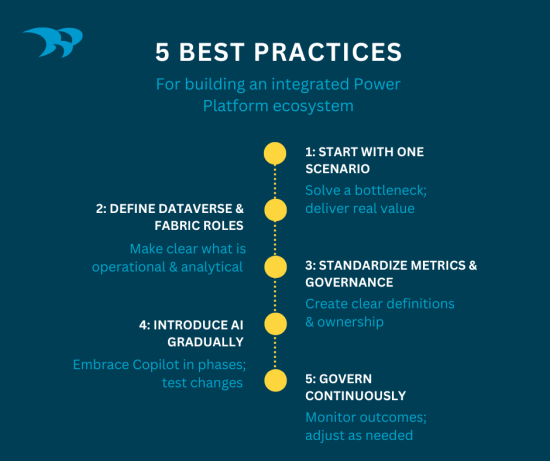
5 Best Practices
Organizations looking to move forward benefit from a measured approach. Here’s how to get started creating your roadmap.
- Start with a high-value, end-to-end scenario rather than a specific tool. Focus on a bottleneck or opportunity where better insight and responsiveness would make a real difference.
- Define early how Dataverse and Fabric work together. Be explicit about what is operational and what is analytical to avoid building two “truths.”
- Standardize metrics, definitions, and governance before expanding AI use. Shared meaning is what allows intelligence to scale.
- Introduce Copilot and agent-based capabilities gradually. Test changes, monitor outcomes, and plan for rollback when behaviour shifts unexpectedly.
- Not every process needs disruption. Stable, efficient workflows should be left alone. The goal is improvement where it matters most.
From Tools to Intelligent Systems
Power Platform executes. Fabric connects the data and insight. AI helps turn insight to action. Together, they enable a move away from disconnected tools toward systems that can improve over time.
The real challenge is not adopting new technology but designing systems that are fit for use. Systems that are aligned with real business processes, informed by good data, and shaped by human judgement. As expectations shift, the role of partners shifts as well: from “building what was written” to helping design what actually works in practice.
That is where this shift becomes meaningful, and where thoughtful design makes the difference. Our clients tell us they value having a partner who takes the time to understand their business needs. Looking to take full advantage of Power Platform? Let’s chat about your needs.