|
Getting your Trinity Audio player ready...
|
Most leadership teams are past the “Should we do AI?” phase. The real challenge is to determine where it will make a measurable difference. For many organizations, it comes down to a practical choice: should AI be used first to improve operational efficiency, or to accelerate revenue growth?
Right now, the pressure is coming from several directions all at once. Boards want proof of ROI. Leaders are working within tighter budgets. And after years of AI hype, there is less appetite for experimentation and more of a hunger for tangible business outcomes.
In Canada, any decisions around AI tend to be tempered by caution. Productivity is a real concern, but so are ethics, accountability, and risk. There is also apprehension around AI errors and unchecked outputs. It’s not just about where AI can be used. It’s about where it can deliver value clearly, safely, and credibly.
To start, leadership teams have to answer a simpler question: what problem are we actually trying to solve? If you cannot name the problem in plain language, AI is not going to magically name it for you.
However, the first step in any serious AI strategy is not choosing the tool and where to use it. It is assessing readiness. Every AI journey begins by getting a handle on your data and processes.
Before Efficiency or Growth: Become AI Ready
AI is only as useful as the data it’s fed and the systems that manage that data. If information is scattered across spreadsheets, email threads, old databases, and half-connected apps, you can absolutely bolt AI on top. But if the underlying data is inconsistent or poorly structured, the output may look convincing, but it’s not to be trusted.
This is why application modernization matters.
Many organizations still work in an environment of disconnected legacy systems, spreadsheets, and human-centred processes. If a lead is qualified, do the next steps happen automatically, or does someone have to copy and paste details into another tool? When that type of duplication happens, it’s not just inefficient, it undermines your ability to generate reliable insights.
A more mature approach starts with a simple premise: one point of input and systems that carry the information forward without manual handoffs. If a contact is entered into a CRM, no one else should need to re-enter that information. Once a lead is qualified, downstream processes should trigger automatically. Data flows. Work moves forward without manual intervention.
This is often where Microsoft Fabric tends to enter the conversation. Not as an “AI tool,” but as a way to bring disparate sources into a more unified data environment so analytics and AI are working with reliable information. The end result is the ability to make decisions with confidence, and eventually in near real time.
Only when that foundation is in place does AI start to deliver real value.
Why Most Organizations Should Start with Operational AI
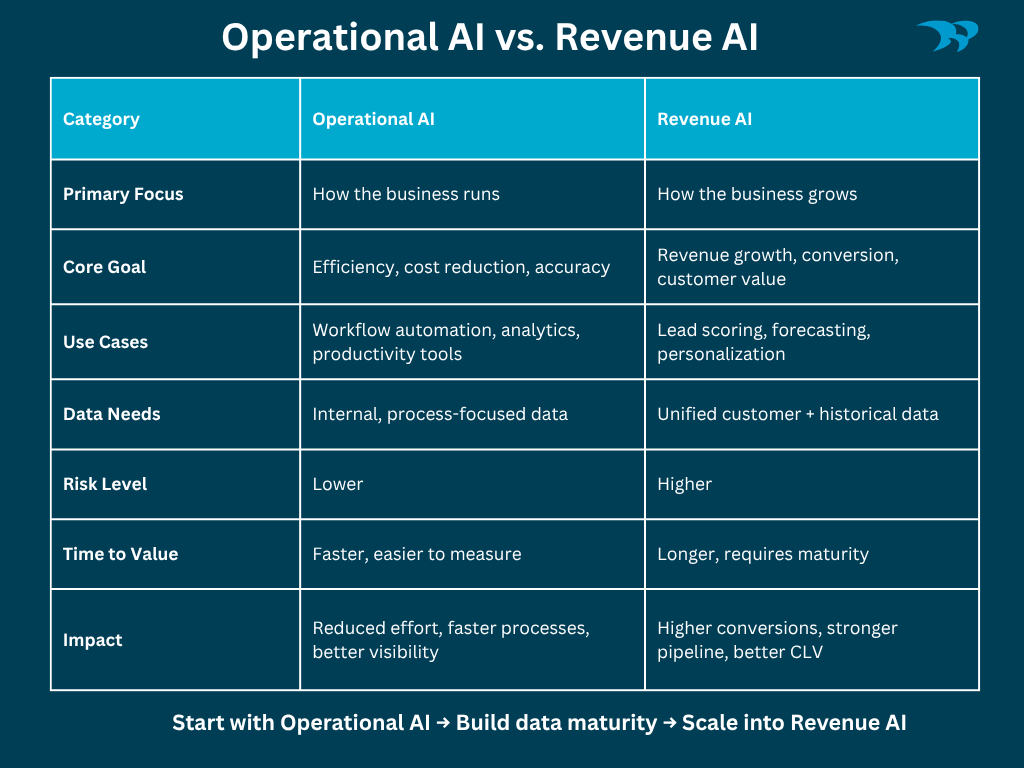
Once the foundation is stable, for most organizations, the smartest place to start is operations, where AI can reduce risk, prove ROI, and build the data maturity needed for more ambitious revenue-focused use cases later on. Not because revenue is unimportant, but because operational improvements are easier to isolate, measure, and control.
In practice, those gains can come from a range of Microsoft-aligned use cases, including:
- Workflow automation using Power Platform and AI Builder
- Productivity support through Copilot in Microsoft 365
- Process automation inside Dynamics 365
- AI-driven analytics in Power BI and Microsoft Fabric
- Predictive maintenance and monitoring using Azure-based AI models
In short, operational AI is about improving how work gets done across the business. At a real-world level, that means reducing overhead, increasing speed, improving accuracy, and giving leaders better visibility into what is happening across teams and processes.
Operational AI tends to create value in two ways:
- Workflow Efficiency: Automating repetitive tasks, reducing manual handoffs between systems, and improving consistency across processes can quietly remove a significant amount of friction from everyday work. Even small improvements in how tasks move through the organization can add up quickly.
- Decision Intelligence: With clean, unified data, AI-driven analytics can detect trends, flag outliers, and surface issues earlier. Instead of relying on static reports about what happened last quarter, leadership teams can begin to see where the business is heading while there is still time to influence the outcome.
That is why operational AI often makes a stronger starting point for many organizations. The risk is lower, it relies primarily on internal data, and tends to produce a clearer ROI. Just as importantly, it helps teams build confidence with AI before expanding into more complex, customer-facing revenue use cases.
Revenue AI: High Potential, Higher Demands
AI for revenue acceleration is compelling and, when done well, transformative. In the right conditions, it can help organizations move faster, improve how opportunities are prioritized, and give leadership a clearer picture of what the future pipeline actually looks like.
Over time, those capabilities can translate into higher conversion rates, stronger customer lifetime value, and more accurate sales forecasts. That winning trifecta is what makes revenue AI so appealing to leadership teams.
Many of the most visible use cases sit inside the Microsoft ecosystem. These include:
- Lead scoring within Dynamics 365 Sales
- Copilot-assisted selling workflows
- AI-driven pipeline forecasting in Power BI
- Customer segmentation powered by Microsoft Fabric
- Marketing personalization across digital channels
- AI agents operating inside CRM workflows
- Dynamic pricing and product recommendations in ecommerce environments
When these capabilities are working well, the benefits can be significant. Sales teams can prioritize higher-quality opportunities, marketing teams can target more precisely, and leadership gains a clearer view of future revenue performance.
However, revenue AI depends on an advanced level of organizational maturity. Dynamic pricing, for example, only works if demand trends are continuously monitored and accurately captured. Forecasting models require reliable historical data. Personalized engagement requires consistent and unified customer records across marketing, sales, and service systems.
Generative AI can also streamline revenue-related work. It can summarize customer conversations, draft follow-up communications, and accelerate sales proposal development. Moving from a meeting transcript to a draft proposal based on previous successful formats is increasingly feasible, saving time across the sales cycle.
Before expanding into revenue AI, organizations need measurable KPIs and mature CRM processes. Leadership teams need to see clear evidence that operational improvements are translating into stronger marketing performance, better pipeline quality, and more predictable growth.
Promises of return on investment are not enough. Real business outcomes matter.
Where It Converges: Revenue Operations and Intelligent Alignment
Ultimately, the goal is not to choose between operational AI and revenue AI. It is to align them, so efficiency gains and revenue growth reinforce one another.
Operational AI strengthens how the business runs day-to-day. Revenue AI focuses on how the business generates and converts opportunity. When those systems evolve separately, organizations often end up with fragmented insights, inconsistent data, and disconnected decision-making. When they are aligned, operational improvements begin to directly support revenue performance.
This is where Revenue Operations becomes important. “RevOps” brings marketing, sales, and customer success onto the same foundation of shared data, shared metrics, and coordinated processes. Instead of each team working from its own version of the truth, the entire revenue cycle operates on consistent information.
Think of marketing, sales, and delivery as a continuous loop. Marketing generates interest. Sales converts opportunity. Delivery fulfills the promise. The outcomes from those engagements then inform the next round of marketing and sales decisions. When these functions operate in silos, performance suffers. When you can connect them through shared data and unified insight, the entire system becomes stronger.
In a modern Microsoft environment, this alignment happens across a connected platform. Fabric consolidates and standardizes data. Dynamics 365 manages customer engagement and pipeline activity. Power Platform connects systems and automates workflows. AI then operates across that shared foundation, identifying patterns, forecasting outcomes, and helping leaders make faster, better decisions.
AI is not a standalone assistant sitting on the sidelines. It is embedded across the organization, strengthening both operational performance and revenue generation at the same time.
Quick FAQ
Q: What is operational AI in a business context?
A: Operational AI focuses on improving how work gets done inside an organization. Common examples include workflow automation, productivity support, predictive maintenance, and AI-driven analytics. These initiatives reduce manual effort, increase efficiency, and provide leaders with better visibility into business performance, often producing faster and clearer return on investment.
Q: What is revenue AI?
A: Revenue AI uses artificial intelligence to help organizations generate and convert more business opportunities. Typical use cases include lead scoring, sales forecasting, customer segmentation, personalized marketing, and dynamic pricing. When supported by strong data and CRM processes, revenue AI can improve conversion rates, pipeline visibility, and customer lifetime value.
Q: Should companies start AI initiatives with efficiency or revenue growth?
A: Most organizations benefit from starting with operational efficiency. Operational AI initiatives—such as workflow automation, analytics, and productivity tools—are easier to measure, carry lower risk, and rely on internal data. Once operational improvements create reliable data and processes, companies can expand into revenue-focused AI such as forecasting, lead scoring, and customer personalization.
Q: Why is data readiness important for AI adoption?
A: AI systems rely on accurate, structured, and connected data. If information is fragmented across spreadsheets, emails, and disconnected systems, AI outputs may appear credible but be unreliable. Preparing for AI adoption requires improving data quality, integrating systems, and ensuring consistent data capture so analytics and AI models can generate trustworthy insights.
Q: What role does application modernization play in AI readiness?
A: Application modernization improves AI readiness by reducing fragmented systems and manual processes. Modern architectures allow data to move automatically between systems, eliminating duplicate entry and improving data consistency. This integration creates the reliable data environment needed for advanced analytics, machine learning models, and AI-driven decision making.
A Practical AI Roadmap for 2026
For organizations working within constrained budgets, getting the sequence right is essential.
A practical roadmap looks like this:
- Assess and improve data quality. Identify where information is stored, how it is recorded, and whether it is standardized.
- Modernize core systems where necessary. Reduce duplication. Eliminate redundant data entry. Create integrated workflows.
- Deploy operational AI in focused, measurable initiatives. Successful AI adoption rarely happens in a single leap. Most organizations move forward through small, measurable initiatives. Capture quick wins.
- Establish and monitor clear KPIs. Confirm that operational gains are delivering tangible business value.
- Expand into revenue-focused AI once the foundation is solid.
Introduce advanced forecasting, personalization, and predictive capabilities when data and processes can support them.
The market is already shifting in this direction. Early AI conversations were often driven by hype. Today, more organizations are asking deeper questions about data readiness, governance, and integration. The focus is moving from experimentation to disciplined implementation.
AI will not fix legacy architecture. It will amplify whatever foundation already exists. The real strategic question is not efficiency versus growth. It is whether the business is prepared to support both in a structured, measurable way.
Start with readiness. Strengthen operations. Then scale into intelligent revenue acceleration. That is how AI becomes a real business advantage.
Where Should Your Organization Start?
Every organization’s starting point with AI is different. Some need to focus first on data readiness and system integration. Others are ready to automate workflows or apply AI to revenue forecasting and customer engagement.
The important step is identifying where AI can deliver measurable impact today while building the foundation for larger gains tomorrow.
If you’re exploring how AI could support your operations, revenue strategy, or data architecture, the Whitecap team can help you assess your readiness and implement practical solutions to move forward with confidence. Talk to us.